
2.1 Multidimensional and Space-Saving Solutions
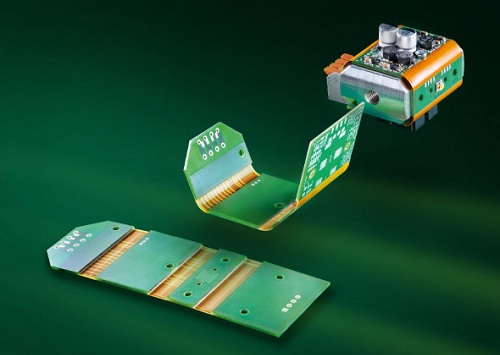
Features & Advantages
- Symmetrical and asymmetrical stackups
- A choice of several technologies for different applications
- More than one flex layer possible
- Impedance across bending area also possible
- Self-supporting, stable 3D structures without the need for additional assembly
- Cost savings through elimination of plug and cable connections
- Optical flexibility thanks to the individual orientation of separate LEDs in lighting applications
Embedded PCB

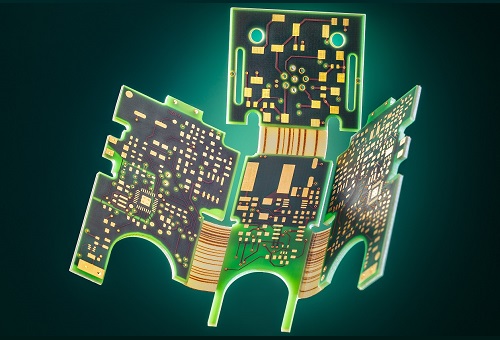
Rigid-flex PCB

Semi-flex PCB
HSMtec® 3D PCB
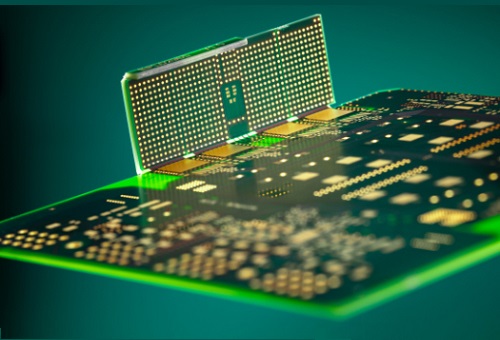
No space on the outer layers? Why not use an additional placement level inside the PCB?
With its embedding technologies, KSG offers the perfect solution for integrating active and passive electronic components – down to a minimum size of 01005 and up to a maximum component height of 2.5 mm.
Learn more
With its embedding technologies, KSG offers the perfect solution for integrating active and passive electronic components – down to a minimum size of 01005 and up to a maximum component height of 2.5 mm.
Learn more
For multiple bends, a rigid-flex PCB is the best choice. This is the ideal solution whenever electrical connections need to be established between several rigid PCBs in different mounting positions and orientations. Rigid-flex PCB technology is extremely versatile when it comes to layout options and geometries. That is why it has become an indispensable component of modern connection technology.
Learn more
Learn more
Semi-flex PCBs can be used as a low-cost alternative to rigid-flex PCB technology.
It offers significant cost advantages over the classic rigid-flex PCB. It also copes extremely well with static bending stress during assembly and installation.
Learn more
It offers significant cost advantages over the classic rigid-flex PCB. It also copes extremely well with static bending stress during assembly and installation.
Learn more
The bendable HSMtec® PCB technology is suitable for one-time bends with a self-supporting function. The selective integration of copper profiles makes it possible to create 3D PCB structures that are self-supporting. As part of this process, electrical and thermal connections can be fully integrated into the PCB. This gives you a high degree of flexibility for a wide range of multidimensional applications.
Learn more
Learn more
Comparison of Multidimensional PCB Technologies
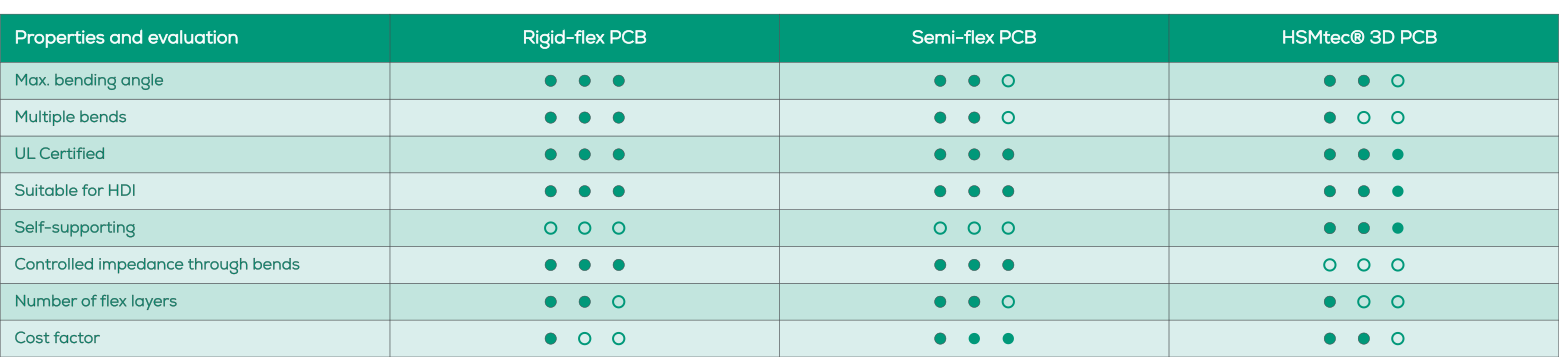
Starting with your initial product idea, our Technical Support Team will be happy to advise you every step of the way as they work with you to find the most suitable PCB solution.
Keywords
- 3D PCBs
- Bendable PCBs
- Self-supporting PCBs
- Multidimensional PCBs
- Miniaturization